
As cyberattacks multiply, Europe is strengthening its regulatory arsenal. The NIS 2 directive is becoming the reference text to raise the cybersecurity level of critical organisations. In France, between 15,000 and 18,000 entities are affected. Are you ready?
The average cost of a cyberattack today represents between 5% and 10% of a company’s annual revenue, according to a report from the French Court of Auditors published in June 2025. For a French SME, that averages €466,000. Staggering numbers that explain why the European Union decided to drastically strengthen its regulatory framework.
Adopted in December 2022, the NIS 2 directive (Network and Information Security) succeeds NIS 1 with a clear ambition: harmonise and raise the cybersecurity level across Europe. The scope widens considerably, from 7 to 18 activity sectors. Obligations strengthen. And penalties become truly deterrent.
From NIS 1 to NIS 2: why this evolution was necessary
The first NIS directive, adopted in 2016, was a first step toward a coordinated cybersecurity approach in Europe. It mainly targeted Operators of Essential Services (OES) and Digital Service Providers (DSP). But its application revealed several limits.
First, a scope too narrow, leaving many critical sectors without binding framework. Then, significant disparities between member states in the interpretation and application of the rules. Some countries were far more demanding than others, creating a form of unfair competition. Finally, often symbolic penalties that didn’t encourage organisations enough to invest in their cybersecurity.
NIS 2 corrects these weaknesses. The directive establishes a common set of stricter rules, uniformly applicable across the European Union. It places greater responsibility on leaders and provides financial penalties that can truly impact negligent companies.

Who is affected by NIS 2?
This is one of the major evolutions of NIS 2: the scope widens considerably. In France, between 15,000 and 18,000 organisations now fall within the scope, compared to about 500 for NIS 1.
The directive distinguishes two categories of entities with different requirement levels.
Essential entities include large organisations (more than 250 employees or more than €50 million in revenue with more than €43 million balance sheet) operating in highly critical sectors: energy, transport, health, drinking water, digital infrastructure, public administrations, space, banking and financial-market infrastructure.
Important entities cover mid-sized companies (between 50 and 249 employees or more than €10 million in revenue and balance sheet) in those same sectors, plus other sectors classed as “critical”: postal services, waste management, chemical production, food production, medical-device manufacturing, electronic and optical equipment, digital-service providers, research organisations.
Important note: some organisations are affected regardless of size: DNS service providers, domain-name registrars or qualified trust-service providers.
NIS 2 also introduces a strong supply-chain requirement. Even if you are not directly affected, your clients subject to the directive can impose cybersecurity obligations on you through contracts.
The concrete obligations imposed by NIS 2
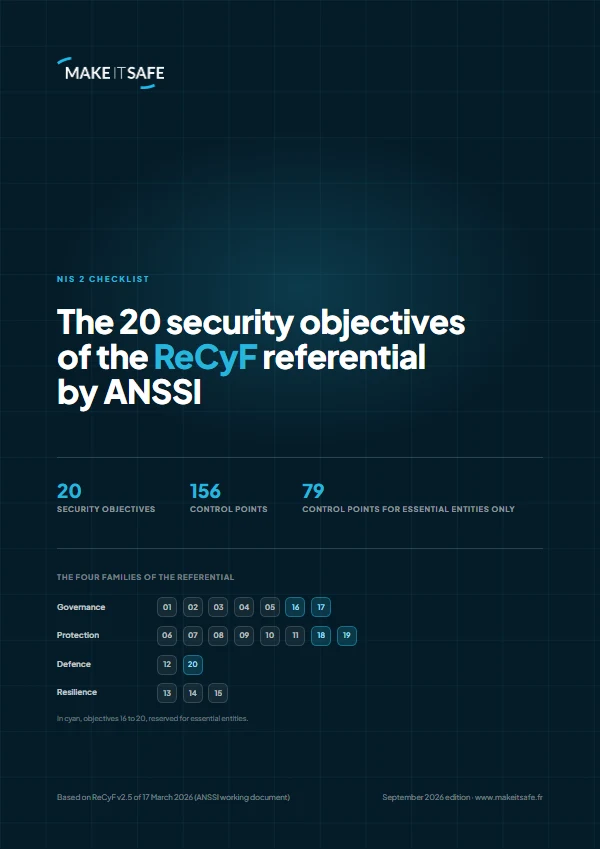
ANSSI, the national supervision authority, defined 20 security objectives for essential entities and 15 for important entities. These obligations cover the full spectrum of cyber-risk management.
Cybersecurity governance becomes a direct responsibility of leadership. Leaders must follow cybersecurity training and actively supervise the implementation of measures. In case of serious breach, they can be personally held accountable and temporarily barred from leadership roles.
Risk management must rely on a rigorous, regularly updated analysis of threats weighing on information systems. Protection measures must be proportional to identified risks and cover the full perimeter: physical security, access control, encryption, network segmentation, vulnerability management.
Incident notification now follows a very precise timeline. For a significant incident, the entity has 24 hours to send an initial alert to ANSSI, 72 hours to provide an assessment report and one month to deliver a final report detailing causes, impacts and corrective actions.
Business continuity requires regularly tested plans to maintain or restore critical activities during a cyberattack: data backup, recovery procedures, crisis management.
Supply-chain security requires entities to evaluate the security posture of their critical suppliers and providers and to embed cybersecurity requirements in their contracts.
A key point to remember: ISO 27001 certification does not guarantee NIS 2 compliance. According to ANSSI, this standard only covers 2 of the 20 security objectives defined for essential entities. Even complemented by ISO 27002, you only reach about 80% of requirements.
Penalties for non-compliance
NIS 2 harmonises penalties across Europe and makes them truly deterrent.
For essential entities, fines can reach €10 million or 2% of total global annual revenue, whichever is higher.
For important entities, the cap is set at €7 million or 1.4% of global revenue.
Beyond financial penalties, authorities can impose binding corrective measures and, in the most serious cases, temporarily suspend certain activities.
Personal leadership liability is another major innovation. In case of gross negligence leading to a security incident, a leader can be barred from leadership roles. This provision aims to place cybersecurity at the heart of board-level concerns.
Where does transposition stand in France?
The European directive required transposition into national law before 17 October 2024. France missed that deadline, and the French text has still not been voted on.
The “Resilience” bill, which transposes NIS 2 (as well as the REC and DORA directives), was adopted by the Senate on 12 March 2025. On 10 September 2025 it cleared a further step with the vote in the National Assembly’s special committee. The debate in plenary session, postponed several times, is expected when parliament returns.
That delay has ended up costing France at European level. After a letter of formal notice in late 2024 and a reasoned opinion on 7 May 2025, the European Commission referred France to the Court of Justice of the European Union on 8 July 2026. It is asking for financial penalties: a lump sum and daily fines until complete transposition is notified.
What the delay means for affected entities
Until the law and its implementing decrees are published, no obligation arising from NIS 2 is enforceable in France. ANSSI puts it plainly: NIS 2 will enter into force in France once all transposition texts, the law, the decrees and the orders, have been enacted. The agency also notes that this entry into force will not coincide with the date on which every regulatory requirement applies.
That reprieve is no reason to wait. The substance of the requirements is known, and ANSSI has already translated it into twenty security objectives in the ReCyF, published in March 2026. Risk analysis and system mapping can start without waiting on the parliamentary calendar.
To check if your organisation is affected, ANSSI provides a simulator on the “Mon Espace NIS 2” platform. A voluntary pre-registration service is also available to anticipate the mandatory registration that will accompany the transposition.
How to prepare for NIS 2: the key compliance steps
Requirements will apply progressively: ANSSI notes that entry into force will not coincide with the date on which every obligation applies, and the detail will be set by the transposition texts. The work itself must start now. Here are the structuring steps of a NIS 2 compliance project, detailed in our guide Running your NIS2 compliance programme, step by step.
1. Run an audit and map your systems. Everything starts with an assessment. An initial NIS 2 audit maps your critical systems and digital assets, identifies vulnerabilities and entry points, and evaluates your security maturity. It sets the priorities and serves as the baseline to measure progress.
2. Deploy proportionate security measures. Protections must match your size, sector and risk exposure: access control, encryption, network segmentation, intrusion detection, vulnerability management. This is the concrete application of the 20 (or 15) objectives defined by ANSSI.
3. Formalise an incident response plan. Document what to do in the event of an attack, assign roles, and align your procedures with NIS 2 notification deadlines (24 h, 72 h, 1 month). Test the plan through simulations to check your teams’ responsiveness in real conditions.
4. Secure your supply chain. Assess the security posture of your critical suppliers and providers, and write cybersecurity requirements into your contracts. Structured third-party assessment is now unavoidable: a breach at a partner can spread across your whole organisation.
5. Engage leadership and train your teams. NIS 2 governance holds management bodies personally accountable, and they must follow dedicated training. Beyond that, raise awareness among all staff: the human factor remains the leading cause of incidents.
6. Maintain continuous monitoring. Compliance is not a fixed state. Real-time monitoring, regular audits and penetration tests (pentests) help detect new vulnerabilities and keep your security level up to date against evolving threats.
How Make IT Safe supports your NIS 2 compliance
Facing NIS 2’s complexity, having the right tool makes all the difference. Make IT Safe is the business software built by cyber experts for CISOs and DPOs who must combine risk control with regulatory compliance.
Our solution lets you structure your NIS 2 compliance journey in an efficient, collaborative way:
- Map your risks using our analysis module that identifies, evaluates and prioritises the threats weighing on your information systems, in line with directive requirements.
- Steer your action plans by centralising every security measure to deploy, with real-time progress tracking and clear ownership.
- Evaluate your third parties to meet supply-chain security obligations. Our supplier-analysis feature gives you a clear view of your ecosystem’s security posture.
- Manage your incidents with workflows aligned to the deadlines imposed by NIS 2 (24h, 72h, 1 month) and documentation meeting ANSSI expectations.
- Demonstrate your compliance through exportable dashboards and reports that showcase your work with leadership and during controls.
100% European, Make IT Safe today supports more than 150 organisations that chose a sovereign, simple and high-performance solution. Our customers report on average 30% productivity gains in managing their compliance.
Preparing for NIS 2 compliance is an investment. But remember: the cost of non-compliance is generally far higher.


