Supplier risk management is now a major strategic stake for companies. As supply chains grow more complex and interconnected, evaluating and controlling risks tied to external partners is crucial. These risks can include service disruption, security gaps or compliance issues that directly affect your organisation.
In this context, regulations such as GDPR, the DORA regulation and the NIS 2 directive impose strict third-party risk-management requirements, and the voluntary ISO 27001 standard provides a framework to meet them. Beyond protecting data, these frameworks also push companies to strengthen information-system resilience.
This article explores how to set up effective supplier risk management while ensuring compliance with the main standards and regulations. We cover risk-assessment methods, action-plan implementation and tools to steer third-party relationships.
Why supplier risk management is essential for compliance
The growing importance of third parties in the value chain
Companies no longer operate in isolation. They collaborate with many external partners to deliver products and services, making supply-chain risk management more complex. These third parties include raw-material suppliers, IT service providers, subcontractors and consultants.
However, third parties can represent significant risks. A single failure or non-compliance can cause production delays, lower product quality or security incidents. A cyberattack at an IT provider could compromise your sensitive data and impact your GDPR or NIS 2 compliance.
Proactive supplier risk management anticipates these risks and protects your company against financial, operational and legal impacts.
Compliance and regulation: a legal and strategic obligation
Current regulations such as GDPR, DORA and NIS 2 require companies to comply with strict third-party risk management requirements; the voluntary ISO 27001 standard provides a recognised framework to implement them. These regulations aim to protect data confidentiality, guarantee continuity of critical services and prevent cyberattacks.
Failing to meet these requirements can trigger significant financial penalties and damage your company’s reputation. A supplier risk-management gap could, for example, lead to a severe GDPR fine or endanger operational resilience under DORA.
In the end, supplier risk management is not just a legal obligation — it is also a strategic decision that strengthens security and performance.

The main steps to steer supplier risk management
Map suppliers and evaluate risks
The first essential step is to build a precise map of your external partners. This mapping lists every supplier, subcontractor and service provider and classifies them by importance to your operations. The more critical a supplier is to your value chain, the more important it is to evaluate and manage its risks. This classification focuses efforts where risks are highest.
Several factors must be considered for a full risk evaluation:
- Financial stability: supplier financial health is a key indicator. A struggling partner is more likely to fail obligations, delay deliveries or reduce service quality. Monitor balance sheets, debt history, single-customer dependency.
- Cybersecurity: with cyberattacks rising, suppliers must meet robust cybersecurity standards. Compliance with ISO 27001 or NIS 2 is a good signal of their security maturity. Your suppliers’ information-system security directly influences your own security.
- Regulatory compliance: verify that suppliers meet the laws applicable to your collaboration. If a supplier processes personal data for you, they must be GDPR compliant. For critical sectors like finance, DORA compliance is also essential.
- Production capacity: suppliers must meet your volume and quality needs while respecting deadlines. Insufficient capacity causes delays that affect your supply chain and delivery times.
- Environmental impact and CSR: Corporate Social Responsibility criteria matter more and more. Customers, investors and regulators expect ethical and responsible practices throughout the supply chain.
Successful supplier mapping gives you a view of your whole ecosystem and quickly identifies critical suppliers. Once mapped, it becomes easier to prioritise actions.
Supplier security audit
Once critical suppliers are identified, run regular audits to guarantee they meet security and compliance requirements. These audits must be rigorous and integrate several aspects:
- Cybersecurity processes: ensure the supplier has protection measures for information systems — encryption, access management, security-incident detection and response protocols.
- Regulatory compliance: suppliers must comply with relevant standards — GDPR, NIS 2 for critical infrastructure, ISO 27001 for information-security management. An audit verifies they follow the required practices and stay up to date.
- Internal risk-management policies: evaluate how the supplier manages its own risks. Do they have solid procedures to identify, monitor and mitigate risks? Do they have business-continuity plans?
- Supply-chain impact: an audit must also evaluate a supplier’s potential impact on your whole supply chain.
Audits must be regular and adapted to risk and supplier-relationship evolutions. An initial audit is not enough — risks evolve, new gaps appear.

Continuous monitoring and risk follow-up
Supplier risk management doesn’t end once audits are done. Continuous monitoring is essential to react quickly to changes:
- Security-incident follow-up: cyber threats evolve fast. Continuous monitoring detects any incident affecting a supplier and enables immediate action.
- Operational performance tracking: monitor supplier performance continuously — delivery quality, deadline adherence, contractual compliance.
- Continuous financial analysis: supplier financial stability can fluctuate. Monitoring key indicators detects signs of trouble.
- Automatic alerts and notifications: modern risk-management tools generate automatic alerts when a supplier’s risk profile changes.
- Risk-assessment updates: regularly reassess supplier risks to factor in changes.
Continuous monitoring combined with proactive management minimises risks and strengthens supply-chain resilience.
Understanding the main regulations: GDPR, DORA, NIS 2 and ISO 27001
GDPR: protect personal data throughout the supply chain
GDPR (General Data Protection Regulation) is a European regulation that frames personal-data protection. It imposes strict obligations on every company collecting, processing or storing personal data, including in relationships with third parties.
In supplier risk management, GDPR requires companies to ensure their suppliers also meet these obligations. A company can be held liable for a data breach committed by one of its providers:
- Verify compliance: before collaborating with a supplier accessing personal data, verify their GDPR compliance — access management, encryption, clear privacy policies.
- Contract clauses: every contract involving personal-data processing must include specific data-protection clauses.
- Regular audits: audit suppliers regularly on their data-processing practices.
DORA regulation: strengthen financial-services resilience
The DORA regulation (Digital Operational Resilience Act), adopted by the European Union and applicable since 17 January 2025, aims to ensure financial-sector companies have systems capable of withstanding IT disruption — notably cyberattacks. It also requires companies to ensure their service providers, especially IT providers, meet high security and resilience standards.
Financial-sector companies must:
- Audit their IT suppliers: ensure providers have deployed enough security measures — disaster recovery and business-continuity plans.
- Monitor incidents: have mechanisms to monitor incidents affecting critical suppliers.
- Deploy emergency plans: DORA requires companies and their IT providers to have clear emergency plans, regularly tested.

NIS 2 directive: a cybersecurity framework for critical infrastructure
NIS 2 strengthens cybersecurity requirements for essential and important entities, classified by sector and size. This regulation requires the entities concerned to secure their information systems and guarantee their suppliers also adopt robust cybersecurity measures.
Companies affected by NIS 2 must:
- Identify critical suppliers: IT providers, subcontractors in critical-infrastructure sectors, energy and telecom suppliers.
- Audit supplier security: ensure suppliers adopt security standards aligned with NIS 2.
- Incident-response plan: develop response plans in collaboration with critical suppliers.
ISO 27001: a global framework for supplier risk management
ISO 27001 is an international standard that sets requirements for an Information Security Management System (ISMS). It offers a complete framework to identify and address information-security risks, including those from suppliers.
Compliance with ISO 27001 involves several actions:
- Supplier risk assessment: evaluate risks tied to supplier access to and processing of information.
- Deploy security controls: impose clear, measurable security controls — access management, system monitoring, threat protection.
- Supplier audits and certification: choose ISO 27001 certified suppliers or run regular audits.
Tools and solutions to ease supplier risk management
SaaS solutions: centralised and collaborative management
SaaS platforms specialised in supplier risk management offer significant benefits. They centralise all third-party information, track risk assessments, manage audits and ease internal collaboration.
These solutions often integrate:
- Dashboards to track supplier performance indicators
- Automated reporting tools for better decision-making
- Real-time incident and non-compliance tracking modules
Automation and AI for risk evaluation
Using automation and artificial intelligence (AI) makes risk management more effective. These technologies let companies identify risks faster, predict problems before they happen and adjust strategy accordingly.
AI can analyse supplier contracts to verify compliance or evaluate financial stability based on public data.
How to deploy an effective supplier risk-management strategy
Embed supplier risk management in your overall strategy
Supplier risk management must be an essential component of your overall company strategy. Too often, companies treat it as secondary when it plays a crucial role in protecting assets, maintaining operational continuity and meeting regulations.
To embed it effectively:
- Alignment with business goals: your supplier risk-management strategy must align with strategic goals.
- Cross-department collaboration: supplier risk management isn’t just a procurement or security concern. Collaborate with different teams (IT, legal, compliance, production) to ensure every aspect of risk is considered.
- Documented policies and procedures: clear, documented supplier risk-management policies are essential for consistent implementation. Include standardised procedures for supplier selection, audits and incident management.
- Performance tracking: set KPIs to track supplier performance over time — financial, operational and compliance aspects.

Train and raise awareness among suppliers
Suppliers play a central role in the supply chain and therefore in risk management. However, not all suppliers are aware of the risks they expose your company to. It is essential to train and raise their awareness:
- Organise regular training: provide specific training on security stakes, data protection (GDPR), compliance standards (ISO 27001, NIS 2).
- Emphasise compliance importance: many suppliers underestimate non-compliance consequences.
- Encourage supplier certifications: push suppliers to obtain certifications like ISO 27001 or SOC 2.
- Open collaboration: encourage transparent supplier relationships — they must feel comfortable reporting problems or incidents without fearing contract breach.
Supplier risk management is a priority for every company wanting to protect its supply chain and ensure regulatory compliance. By adopting a proactive approach, using the right tools and embedding this journey in your overall strategy, you can anticipate threats and strengthen organisational resilience.
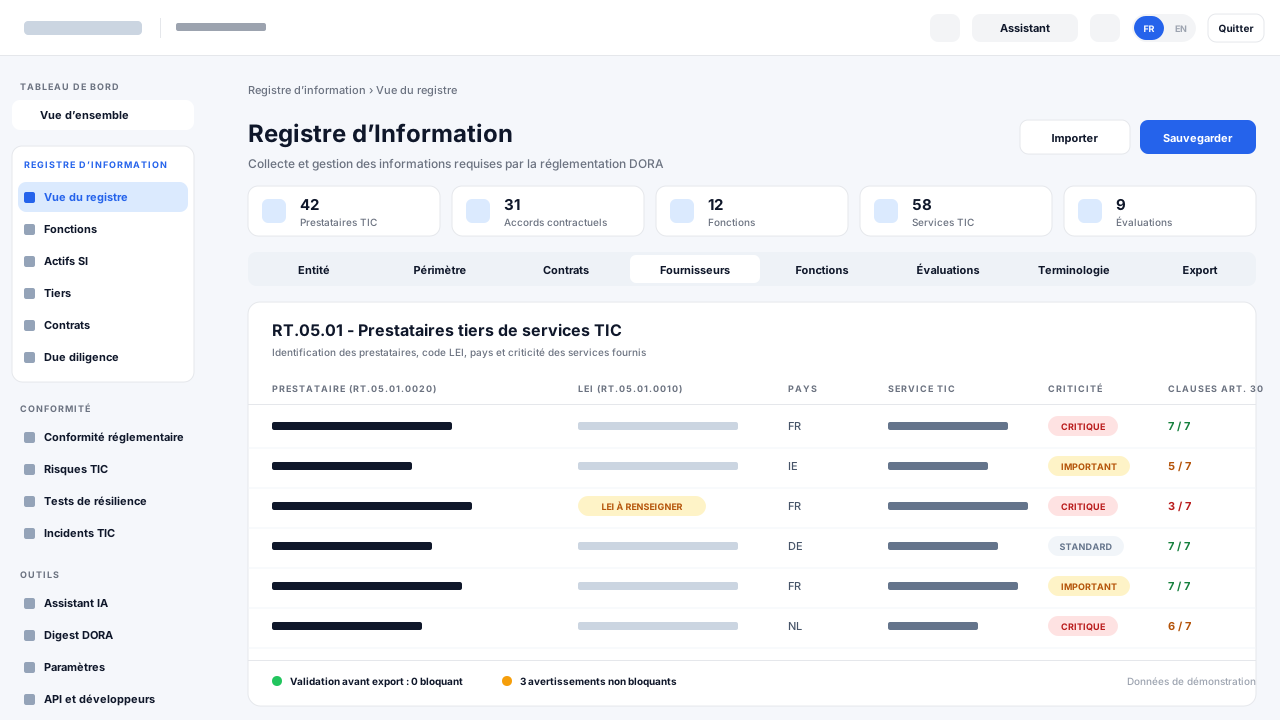
In Make IT Safe, the third-party assessment module brings together your supplier map, the assessment campaigns sent to suppliers, supporting evidence and the resulting action plans, linked to the frameworks you follow. To see a supplier assessment campaign in the tool, request a demo.