Cyber-compliance has become an absolute priority for every company operating in a digital environment. Facing strict regulations like GDPR, NIS 2 and international standards like ISO 27001, organisations must ensure data protection and meet legal security requirements. This article explains cyber-compliance in depth — why it’s essential and what best practices to adopt to meet the main regulations.
Cyber-compliance definition
Cyber-compliance is the set of measures, processes and regulations companies must respect to protect information systems, guarantee data security and meet legal obligations. Today, most organisations face growing digital-compliance requirements dictated by frameworks like GDPR (General Data Protection Regulation), the NIS 2 directive, or international standards such as ISO 27001.
Why cyber-compliance is so important
With multiplying cyberattacks, companies must ensure systems meet the strictest security standards. Goal: protect internal data and data from customers and partners. Bad compliance management can cause severe sanctions — hefty fines or data breaches damaging reputation.
Cyber-compliance matters for several reasons:
- Protect data: companies must guarantee sensitive-information security per regulations.
- Avoid sanctions: non-respect of GDPR or NIS 2 can trigger significant fines and legal penalties.
- Reinforce trust: compliant companies strengthen trust with customers, partners and investors — essential for sustainable growth.
- Ensure resilience: being compliant builds better capacity to react to security incidents, ensuring business continuity.
Main cyber-compliance regulations
To ensure compliance, companies must meet strict regulations protecting data and reinforcing system security. Regulations vary by sector and location but some are unavoidable.
GDPR: protecting personal data
The General Data Protection Regulation (GDPR) is the best-known data-protection regulation. Applies to any company collecting, processing or storing personal data of EU residents, whatever its sector or size.
Main GDPR requirements:
- Legal basis: every processing operation must rely on one of the six legal bases of Article 6, consent being one of them. Explicit consent is only required in specific cases, for instance for sensitive data.
- Right to erasure: individuals can request data deletion at any time.
- Transparency: companies must be transparent about collected-data usage.
- DPO nomination (Data Protection Officer): for some companies, designating a DPO is mandatory.
Non-respect can trigger fines up to 4% of global annual turnover or €20 million, whichever is higher.

NIS 2: reinforcing information-system security
The NIS 2 directive extends the 2016 NIS directive, aiming to improve network- and information-system security levels across the EU. Targets essential and important entities, classified by sector and size, in critical sectors: digital providers, banks, hospitals and other essential infrastructure.
Key NIS 2 points:
- Incident management: deploy mechanisms to detect, manage and notify security incidents to a competent authority.
- Incident-response plan: companies need clear procedures to react quickly.
- International cooperation: fosters member-state cooperation on threat and incident sharing.
NIS 2 non-compliance can trigger sanctions — in some cases, criminal sanctions for company leaders in cases of serious negligence.
ISO 27001: international information-security standard
ISO 27001 is an international standard setting the requirements for deploying an Information Security Management System (ISMS). Has become a global standard guaranteeing companies manage information-security risks efficiently.
Includes:
- Risk evaluation: identify and evaluate potential threats.
- Security measures: deploy security controls to mitigate risks.
- Compliance audit: ISO 27001-certified companies undergo regular audits.
ISO 27001 certification offers competitive advantage — proof that the organisation takes information security seriously.

DORA: operational resilience in finance
DORA (Digital Operational Resilience Act) is specifically aimed at financial-sector companies. Goal: ensure European financial institutions can resist and respond to cybersecurity incidents without operations disruption.
Key DORA requirements:
- Resilience tests: regularly test capacity to resist cyberattacks and service interruptions.
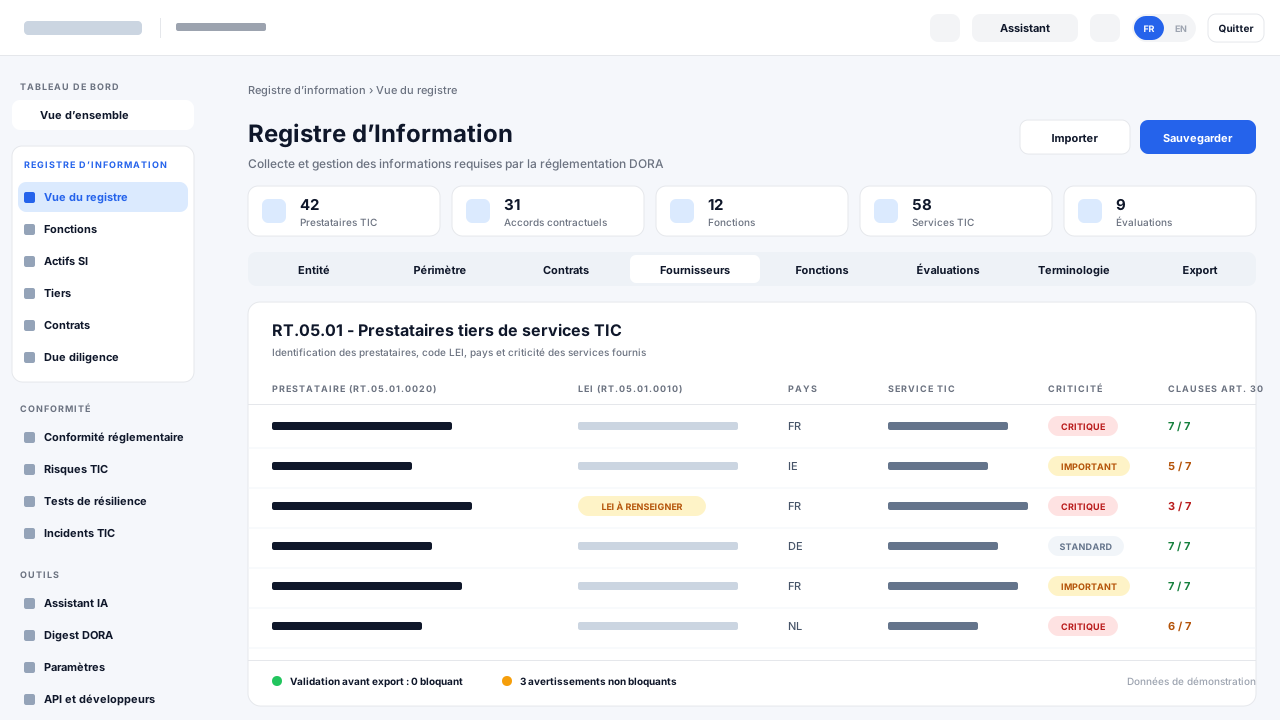
- Supplier surveillance: financial institutions must continuously audit IT service providers.
- Compliance reports: regular reports to regulators.
DORA creates a harmonised framework across the EU.

Cyber-compliance stakes for CISOs and DPOs
CISOs and DPOs are at the heart of company cyber-compliance strategy. Distinct roles but a common goal: ensure data and system security while respecting regulatory requirements. Constant pressure — managing cyber threats, complex regulations and diverse teams.
Reduce cyber risks and sanctions
Main missions: reduce risks of data breaches and security incidents. A serious incident can be disastrous financially and for reputation:
- Avoid fines: GDPR non-respect can trigger heavy fines up to 4% of annual turnover.
- Prevent reputation damage: a data breach or cybersecurity incident can severely harm brand image.
- Ensure business continuity: CISOs must ensure information systems are protected against cyber threats. Deploying continuity plans, and a Supplier Security Assurance Plan (SSA) with the providers that host or operate these systems, is crucial.

Manage internal and external stakeholders
CISOs and DPOs navigate a complex environment with many stakeholders:
- Internal collaboration: business, IT and legal teams must work together. CISO and DPO are conductors easing communication and collaboration.
- Supplier verification: companies depend on external providers. Essential to regularly audit suppliers on compliance standards. Includes compliance clauses in contracts and regular audits.
Maintain constant watch on new regulations
Cybersecurity regulations evolve constantly. Essential to maintain legal and technological watch:
- Adaptation to new requirements: each new directive or update requires process and technology adjustment — policy updates, infrastructure changes, additional training.
- Anticipating future regulations: recent or upcoming texts, such as the AI Act on AI, applicable in stages since 2025, or rules on health data, may impose new requirements.
How to deploy an effective cyber-compliance strategy
A defined strategy must integrate all applicable regulations for your sector. Systematic approach helps manage risks, reduce incident costs and ensure long-term data protection.
Map risks and non-compliance points
First step: map all cybersecurity and compliance risks. Take stock of organisational IT security, identifying vulnerability points:
- Run security audit: in-depth audit of information systems to identify potential vulnerabilities. Can include penetration tests.
- Evaluate risks: measure potential impact of each vulnerability. Includes risks tied to third-party suppliers and external partners.
- Prioritise actions: prioritise corrective actions based on potential impact.
Embed security in every project (ISP)
Embedding information security in projects — often called Security by Design — includes security measures from the design phase:
- Evaluate risks from the start: before launching a project, run a risk evaluation to ensure appropriate security measures are integrated.
- Train teams: development and deployment teams must be aware and trained on security best practices — access management, data encryption, API security.
- Regular controls: run regular compliance audits to ensure systems meet security requirements.
Track and steer compliance actions
Once deployed, regularly track and steer measures via compliance dashboards centralising information:
- Compliance dashboards: CISOs and DPOs track action-plan evolution in real time, generate reports and adjust measures.
- Regular updates: action plans must be regularly updated to reflect regulatory evolution (NIS 2, DORA) and new risks.
- Compliance reports: regular reports to demonstrate compliance to authorities and internal stakeholders.
Essential for continuous compliance and avoiding sanctions.

Best practices for long-term compliance
Requires a proactive approach and continuous management. Not just compliance at one moment — ensuring the organisation stays compliant despite evolving threats, technologies and regulations.
Team awareness and continuous training
Employees play a key role. Even with the best tech and processes, a simple human error can compromise cyber-compliance. Essential to deploy awareness programmes and continuous training for every member, not just IT.
- Risk awareness: each employee must understand cybersecurity risks — phishing, data leaks.
- Regular training: sessions to keep staff current on security policies and latest threats.
- Roles and responsibilities: clear communication of everyone’s role.
Update your strategy as regulations evolve
Regulations constantly evolve. Adapt your compliance strategy:
- Regulatory watch: maintain legal watch to anticipate changes like NIS 2, DORA or emerging texts. Rely on internal or external experts.
- Policy updates: adjust internal policies with each new legislation.
- Anticipate future regulations: some texts apply in stages, like the AI Act, and others are still being drafted, for instance on health data.
Regular audits and controls
Run regular audits to verify practices respect current standards:
- Internal audits: in-house checks on policy application.
- External audits: use independent experts for objective evaluation. Particularly relevant for certifications like ISO 27001.
- Continuous surveillance: beyond one-off audits, continuous monitoring rapidly identifies incidents.

Cyber-compliance is no longer optional — it’s a necessity for any organisation wanting to ensure system security, protect data and respect regulations. With an adapted strategy and the right tools, companies can meet legal requirements, reinforce reputation and gain customer and partner trust.