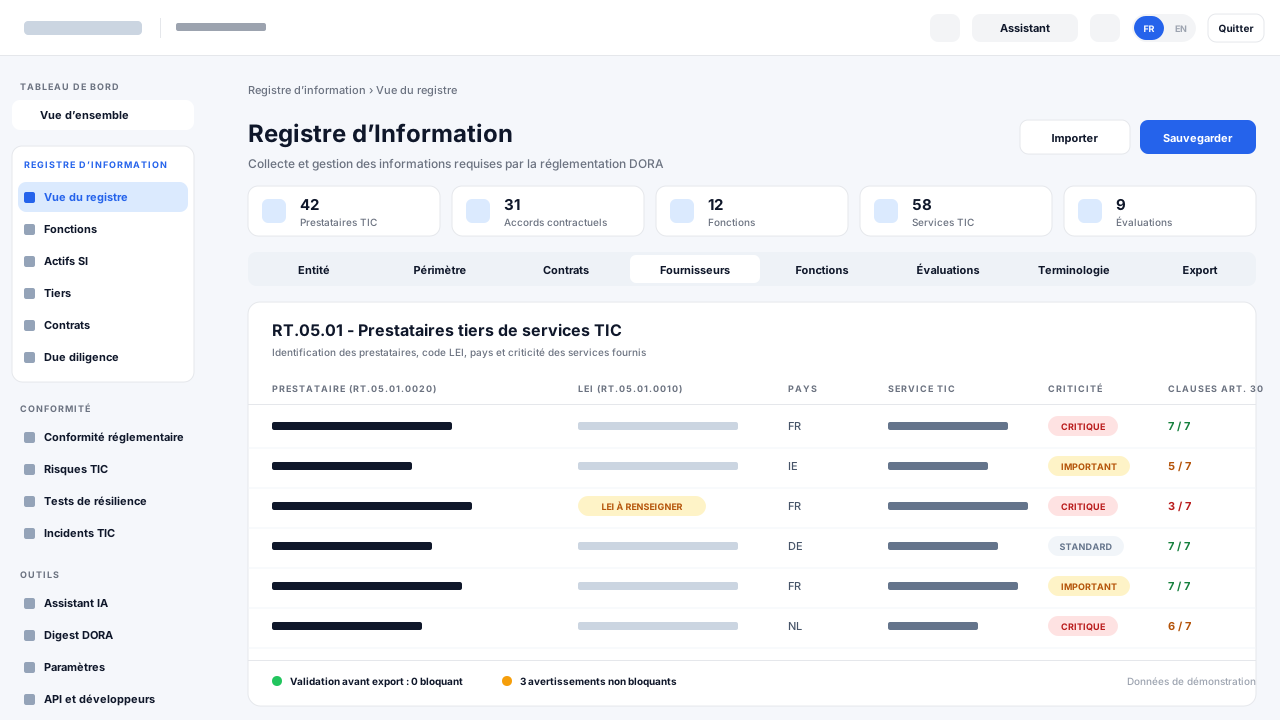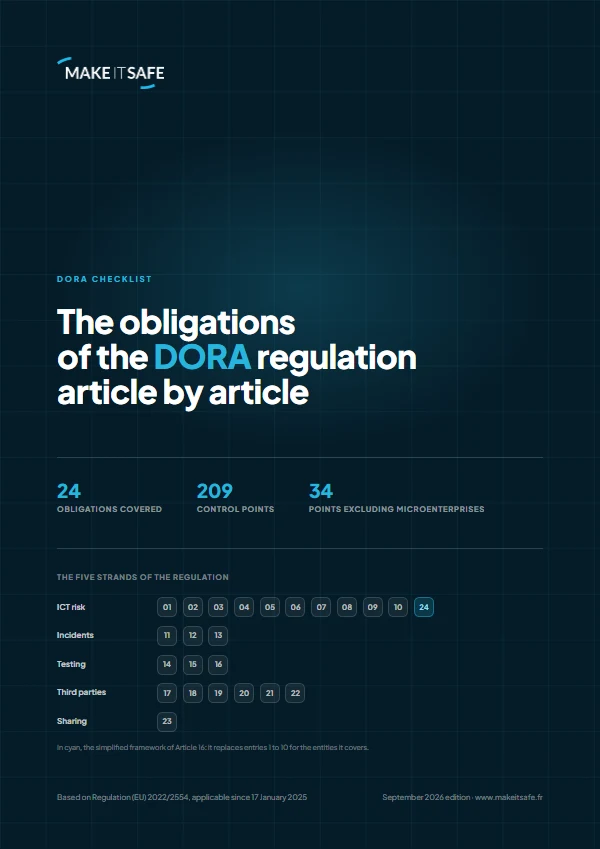
The digital transformation of financial companies has opened many opportunities but also increased operational risks, notably cyber threats. To address these challenges, the European Union introduced the DORA regulation (Digital Operational Resilience Act). This framework, in force since 16 January 2023 and applicable since 17 January 2025, aims to strengthen financial entities’ operational resilience against digital risks. This article guides you through the stakes, implications and ways to comply with the new regulation.
Understanding DORA: stakes and implications
What is DORA?
DORA is a major European Union legislative initiative to guarantee financial entities’ operational resilience against digital risks. In the age of digital transformation, where financial services increasingly rely on ICT, this regulation responds to the growing need to protect critical infrastructure against cyber threats.
It creates a harmonised European framework where every financial entity, whatever its size, must comply with strict ICT risk-management standards. This includes sensitive-data protection and operational continuity during ICT incidents. It aims to strengthen financial stability and preserve trust in the digital market.
The framework responds to a context where IT security incidents — cyberattacks, system failures, third-party provider failures — can have devastating economic consequences. DORA sets clear requirements for monitoring, resilience testing and information sharing with competent authorities.
Who is concerned and what are DORA’s pillars
DORA applies to a broad range of players: financial entities (banks, insurers, asset managers), market operators (exchanges, trading venues, clearing houses), third-party IT providers — cloud providers first and foremost, now directly supervised — and the national and European supervisory authorities.
The regulation rests on five pillars:
- ICT risk management (identification, assessment, mitigation);
- management, classification and reporting of ICT-related incidents;
- digital operational resilience testing;
- management of ICT third-party risk;
- information sharing on cyber threats between financial entities.
DORA stakes for companies
DORA introduces important stakes. It imposes a rigorous, proactive approach to digital risk management. Companies must not only comply with strict standards but also rethink and adjust internal processes.
One key stake is guaranteeing financial-service continuity during an incident. That requires meticulous preparation: identify ICT-system vulnerabilities and deploy robust security measures. DORA doesn’t just prevent risks — it also requires companies to be ready to react quickly during a cyberattack.
Another major stake concerns third-party provider relationships. In an outsourcing-heavy world, DORA requires close supervision to ensure providers meet operational-resilience standards. Clear contracts, regular audits and continuous communication are essential.
DORA also directly impacts reputation. Non-compliance or inadequate incident management can trigger severe penalties and erode customer and partner trust. To stay competitive and credible, companies must not only comply with DORA but also demonstrate proactive, transparent risk management.
Non-compliance implications
Non-compliance has significant repercussions. Financial penalties can be severe — high fines imposed by regulatory authorities. These sanctions can directly affect financial results.
Beyond fines, non-compliance can lead to operational restrictions. Competent authorities can limit company activities or suspend operations until DORA requirements are fully met. These restrictions can severely affect service continuity.
Reputation impact is also a major consideration. In a trust-driven sector, a non-compliant company risks losing customer, partner and investor trust.
Non-compliance also increases cyberattack risk. By not meeting DORA’s strict ICT system security requirements, the company becomes an easier target for cybercriminals.


DORA and cyber-risk management
DORA’s importance in cyber-risk management
Cyber-risk management is a priority for every financial-sector company, and DORA plays a crucial role. By requiring rigorous ICT risk evaluation, DORA pushes companies to adopt a systematic approach to identify, analyse and mitigate potential risks.
DORA particularly emphasises operational resilience — the ability to withstand a cyberattack or digital disruption, keep functioning during the incident and recover quickly. This holistic approach is essential to minimise cyber-threat impact on operations and reputation.
DORA’s operational-resilience testing requirements reinforce this proactive approach. These tests let companies simulate different incident scenarios to evaluate system and process robustness.
How DORA contributes to sensitive-data protection
Sensitive-data protection is essential in DORA. In a context where data breaches can trigger significant financial losses and reputation damage, DORA imposes strict standards — rigorous access controls, encryption, monitoring protocols.
Beyond protection measures, DORA requires companies to quickly notify security incidents to competent authorities. This notification obligation ensures regulators are informed of breaches and can intervene to minimise damage.
DORA also encourages an integrated risk-management approach, where data protection is part of a global operational-resilience strategy. Aligning DORA requirements with other regulations like GDPR creates a consistent framework.
Regulatory impact on cybersecurity strategies
DORA has a deep impact on cybersecurity strategies. By imposing strict ICT risk-management requirements, it forces companies to review and strengthen security strategies — embedding operational resilience in strategic planning, deploying advanced incident-detection and response technologies, and continuously improving risk-management processes.
A key change is the focus on third-party provider collaboration. Companies must ensure partners and suppliers also meet security and resilience standards. This drives greater coordination and more rigorous third-party relationship management.
DORA also pushes companies toward proactive cybersecurity. Rather than reacting to incidents, companies are encouraged to anticipate threats, run regular resilience tests and strengthen response capabilities.
DORA compliance challenges
Complexities of DORA compliance
DORA implementation is a major challenge — particularly due to the complexity and rigour of the requirements. One of the first obstacles is deeply understanding the regulatory framework and translating requirements into concrete actions.
Third-party provider management is another complex aspect. Companies must monitor both their own systems and those of their partners — verifying each actor’s resilience capabilities and deploying strong contracts.
DORA also requires an integrated ICT risk-management approach, aligning risk-management processes with DORA’s specific requirements while adapting to fast-evolving digital threats.

Challenges of deploying DORA
Deploying DORA requirements also raises practical challenges. One of the main difficulties is integrating new requirements into existing processes without disrupting current operations.
Another major challenge is training and awareness. Employees, especially those directly involved in ICT risk management, must be trained on new requirements and best practices.
Companies also face budget constraints. Deploying DORA may require substantial investments in new technologies, audits and additional human resources. For SMEs especially, these costs can be a significant burden.
Solutions to overcome DORA compliance challenges
Companies can adopt several strategic approaches. One of the most effective is using specialised SaaS platforms that centralise ICT risk management and automate many tasks — real-time operational-resilience monitoring, compliance report generation, process alignment with DORA.
Support from cybersecurity and regulatory-compliance experts is also crucial. They provide personalised advice, identify risk zones and help deploy the necessary processes.
Finally, a collaborative approach, internally and externally, is essential. Encourage communication between teams to ensure every department understands and respects DORA. Externally, strengthen cooperation with providers.
DORA and internal and external collaboration
Importance of internal and external collaboration for DORA compliance
DORA success relies largely on effective collaboration. Inside the company, every department — from IT to executive leadership — must understand DORA requirements and work together. ICT risk management shouldn’t be just IT’s responsibility; it requires an integrated approach.
Internal collaboration ensures that every measure aligns with strategic goals.
External collaboration, especially with third-party providers, is equally important. Financial entities must ensure partners meet DORA’s security and resilience standards. This requires continuous, transparent communication, regular audits and specific contract clauses.

How DORA drives better stakeholder communication
DORA doesn’t just impose resilience standards — it also drives better stakeholder communication. By requiring rapid security-incident notification, DORA encourages a transparency and collaboration culture.
Inside companies, the regulation drives adoption of clear ICT-incident communication protocols. Teams must be trained to immediately report potential incidents and follow established procedures.
DORA also drives better industry collaboration. By harmonising operational-resilience requirements across the European Union, it creates a framework where companies can share best practices.
Protect your company by complying with DORA
DORA is a crucial turning point for financial entities, pushing them to strengthen operational resilience against digital risks. While DORA compliance presents important challenges, it also offers an opportunity to strengthen data security, guarantee service continuity and maintain customer and partner trust.

By adopting a proactive approach and investing in advanced technology solutions, companies can not only comply with DORA but also improve overall resilience. Close collaboration between every stakeholder, internally and externally, is the key to success. DORA has applied since 17 January 2025: the challenge is no longer to prepare for it but to sustain compliance over time, including the register of information, testing and provider oversight.