The market for governance, risk and compliance solutions has grown denser with the arrival of NIS2, DORA and the AI Act: DORA has applied since January 2025, the AI Act is coming into application in stages and NIS2 is still awaiting transposition in France. Getting equipped with a GRC tool has become a reflex for structuring a serious cyber programme. Behind the acronym, however, the scope varies enormously from one vendor to the next.
A poorly chosen tool mainly costs operational time to cyber and compliance teams that are already stretched. This article offers a reading grid to avoid that situation.
GRC: one acronym, very different scopes
The term GRC is claimed by players that have almost nothing in common: ERP vendors, risk specialists, questionnaire platforms, compliance start-ups. Two solutions labelled “GRC” may share no use case at all. Understanding a tool’s philosophy before comparing prices avoids a lot of disappointment.
Why the acronym has become meaningless
For some vendors, GRC amounts to a document repository where security policies are filed. For others, it is a risk analysis engine built on EBIOS RM or ISO 27005. That elasticity makes it possible to sell a ticketing tool as a governance platform. A genuine governance, risk and compliance software connects the three dimensions, without re-entering data between them.
Document-led approach, steering-led approach
A document-led approach proves that you have written rules. A steering-led approach shows that they are applied, with dated evidence and identified owners. An external auditor today asks for the trace of application: who did what, when, on which scope. A security policy PDF stored in a document management system does not answer that question.
The automation expected in 2026
Current tools include API connectors that pull technical evidence from your environments: cloud, directories, vulnerability scanners, asset management tools. That collection reduces friction with operational teams and keeps data fresh between two audits. Manual entry remains useful for organisational measures, much less so for technical controls.
The four main families of tools on the market
Before comparing features, identify which family the solution under evaluation belongs to. Each answers a different business priority.
Compliance management solutions
They are built around specific frameworks: ISO 27001, GDPR, SOC 2, ANSSI’s hygiene guide. Questionnaire management, self-assessment, production of compliance reports: that is their ground. They suit organisations whose immediate objective is a certification or a legal obligation to meet.
Risk management tools
Risk analysis sits at the centre: asset mapping, threat identification, impact assessment, scenarios. They address risk managers who want a probabilistic and financial view of cyber exposure. Compliance is treated as a consequence of risk treatment.
Third-party management platforms
The interconnection of ecosystems has turned supplier risk management into a discipline of its own. These tools automate the sending and chasing of questionnaires, consolidate responses and track third parties’ external security ratings. DORA has made this link mandatory for financial entities and their critical providers.
Integrated GRC suites
They cover compliance, risk, third parties, internal audit and sometimes incident management. The promise of centralisation is real, and so is the implementation effort. They suit large groups that have dedicated teams per module and a need for consolidation at group level.
The selection grid: technical and functional criteria
A scoring grid is worth more than a list of ticked features. Score each criterion against your own use cases, not against those of the sales deck.
Framework coverage and updates
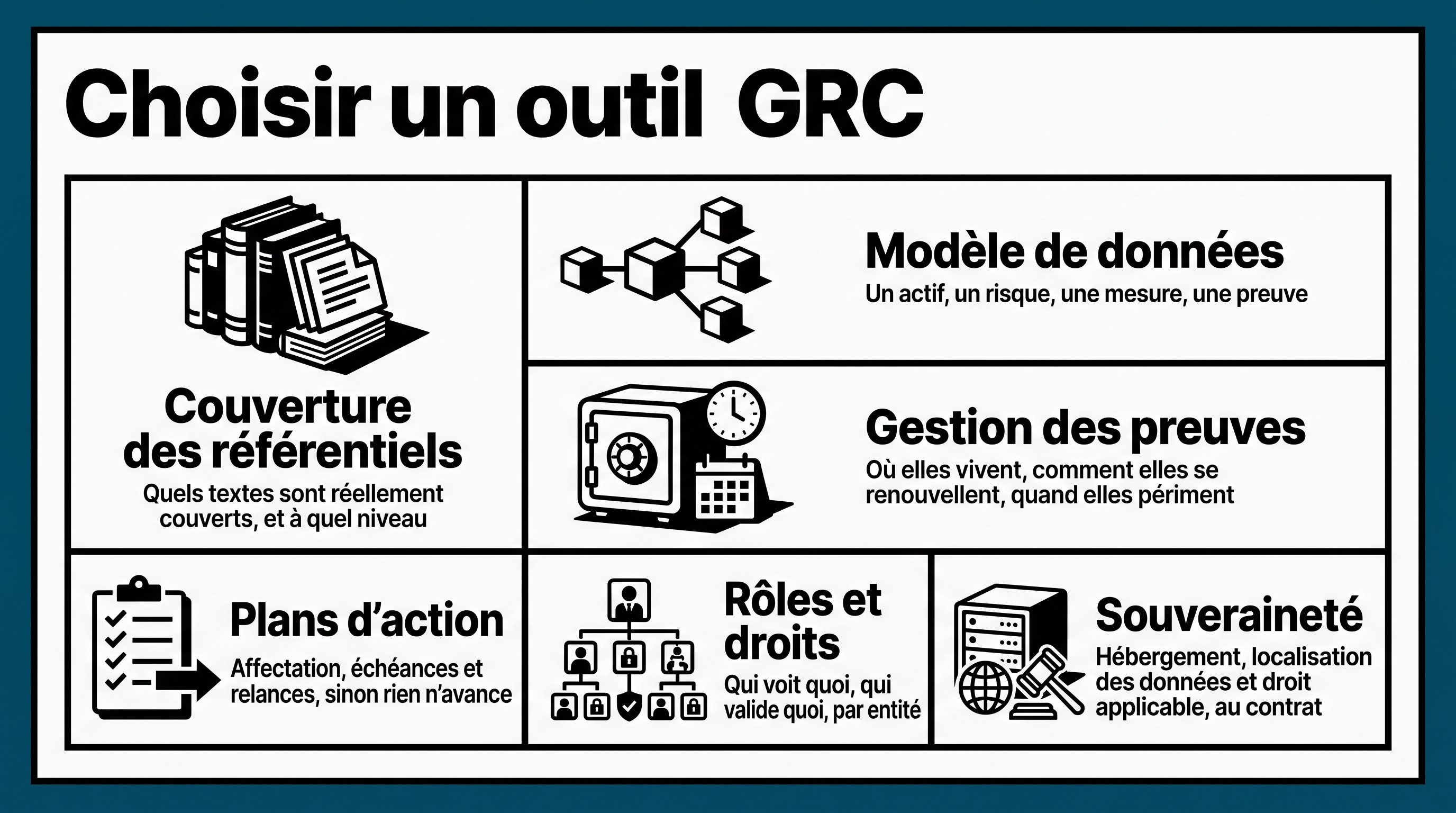
Look at the native library: up-to-date versions of ISO 27001:2022, NIS2, DORA, sector frameworks. Above all, ask about maintenance. If every regulatory change requires custom development or a billed engagement, cost will climb with every new text published. The tool must also map a single control onto several frameworks, so the work is done only once.
Data model and flexibility
Your organisation has its subsidiaries, its geographic entities, its risk matrix and its rating scales. A rigid data model forces you to bend your processes to fit the software, and users disengage. Check what you can configure yourself, without a ticket or vendor intervention.
Evidence management and automated collection
This is the first point of friction in the field. A good tool automatically chases contributors and attaches each piece of evidence to the corresponding requirement and action. Versioning, timestamping, traceability of approvals: without those three, external audits are still prepared by hand.
Steering collaborative action plans
Compliance involves several people: CISO, DPO, IT, legal, business lines. Readable approval workflows, useful notifications, a simple screen for the occasional contributor who logs in twice a quarter. An interface that is too dense, and progress will never be recorded.
Reporting and dashboards
A CISO communicates in two directions: operational teams and executive management. The tool must produce dynamic dashboards and exportable reports for an executive committee, without spending a day in PowerPoint before every management review. Ask to see a real report, not a mock-up.
Questions to ask during the demonstration
The sales demonstration is a well-rehearsed exercise. A few concrete requests are enough to measure the gap between the pitch and the product.
Have them test importing and exporting your data
Ask the vendor to import your risk tracking spreadsheet during the demo. If the operation takes two hours and a consultant, onboarding will be long. Check the export too: your data must come out in a usable format, CSV or JSON, without going through a service request.
Look at the interface from the business contributor’s side
Most users are not cyber experts. Ask for the screen that a procurement manager will see when asked to answer a supplier questionnaire, or a project manager approving an action. A screen saturated with technical fields makes adoption collapse in the weeks following deployment.
Check how deep the API goes
Ask for the documentation, not a screenshot. Can you create a Jira ticket from a GRC action plan? Pull scores from a vulnerability scanner? Synchronise users from the directory? Without interoperability, duplicate data entry comes back through the window.
Hosting and sovereignty
For operators of essential services, NIS2 essential entities and financial players under DORA, the location and legal regime of the data weigh as much as the features.
What your GRC data contains
Your GRC database describes your known vulnerabilities, your compliance gaps, your overdue action plans and your supplier dependencies. It is the map of your weak points. Entrusting it to a vendor subject to extraterritorial laws such as the Cloud Act deserves, at the very least, a documented risk analysis.
SecNumCloud and certifications
Favour hosting in France on infrastructure that is SecNumCloud-qualified or ISO 27001 and ISO 27701 certified. Make IT Safe is hosted in France at OVHcloud and 3DS OUTSCALE, in data centres certified ISO 27001/27701 and SecNumCloud-qualified, with encryption at rest and in transit, RBAC and MFA, following ANSSI and CIS recommendations.
The contract clauses to read again
Reversibility: within what timeframe do you get your data back after termination, and in which format? Sub-processors: who accesses production, and from which country? These clauses often come after features during negotiation, and prove expensive on the way out.
The real cost of a GRC tool
The annual licence fee is only part of the total cost of ownership. Three items recur in projects that overrun.
Migrating what you already have
Moving from spreadsheets to a structured database requires cleaning work: duplicate risks, controls worded differently across entities, assets with no owner. Budget for that work before the import, not during. Some vendors include it in their onboarding, others bill it through partners.
Initial configuration
Roles, permissions, approval workflows, rating scales, acceptance thresholds: none of this can be configured without the CISO and the DPO. Assess the bandwidth available internally during that phase, or budget for consulting.
Licensing models
Per-named-user billing pushes you to limit access, and therefore to reduce collaboration at the very moment you are trying to broaden it. Billing by scope, by number of entities or assets, is more predictable. It is one of the criteria for choosing GDPR compliance software or cyber software that determines real adoption. Also check the cost of additional modules and renewal tiers.
Warning signs during evaluation
Some projects fail six months after signature, despite a fully completed criteria grid. Three signals can be spotted during evaluation.
The over-engineered platform
Three days of training to create a corrective action is the sign of a tool calibrated for an organisation other than yours. A clean interface takes a lot of work on the vendor’s side, and it shows during a demonstration. Time the everyday gestures: creating a risk, attaching evidence, chasing a contributor.
Rigidity in the face of new texts
A vendor that takes a year to integrate a new framework sends you back to spreadsheets to manage it in parallel. Data silos, duplicates, inconsistent indicators: the benefit of centralisation disappears. Ask for the update cadence of the framework library over the last twenty-four months.
Support and guidance
Anonymous ticket-based support, in a distant time zone, holds up poorly on a tool this sensitive. You need people who know French and European regulation. A dedicated customer success manager, reachable, who points you to good practice, changes daily life for a compliance team.
Key takeaways
- Set your priority: compliance, risk analysis or third-party management, before surveying the market.
- Check the hosting: data located in France, certified infrastructure, reversibility clauses read.
- Test adoption: a GRC tool only produces value if the business actually uses it.
- Measure automation: API depth, evidence collectors, automatic chasing.
- Cost the TCO: configuration, migration, additional modules, skills ramp-up.
- Probe flexibility: the data model must fit your organisation.
- Secure the exit: full export of your data, at any time, with no dependency on the vendor.
Frequently asked questions
Should you choose a dedicated tool or an integrated suite?
It depends on your size and organisational complexity. For a company of 250 to 5,000 employees, a specialised solution with good integration capabilities deploys faster and costs less than a GRC ERP suite. The point to watch is communication with the rest of your ecosystem through APIs.
Does a GRC tool replace a cyber expert or a DPO?
No. It absorbs repetitive tasks (chasing, consolidation, formatting tables) to leave the expert time for analysis and arbitration. Steering stays human.
How long does it take to put a GRC solution into production?
Technical provisioning of a SaaS solution is immediate. The real timeline depends on configuration and on the quality of the data to be migrated: from a few weeks to several months depending on the vendor. Make IT Safe goes into production in under 4 weeks.
Can you manage several frameworks in a single tool?
Yes, and that is the main benefit of a multi-framework approach. A strong password policy answers both an ISO 27001 control and a GDPR security requirement: the evidence is captured once and feeds both control plans.
What is the role of AI in GRC tools in 2026?
Assistance in drafting policies, automatic mapping between frameworks, consistency checks on evidence, suggested action plans based on detected vulnerabilities. Human validation is still required, and the data processing performed by those functions must be documented in your register.
Going further
Start with an inventory of your current processes and tracking files. Identify your three main friction points: time spent on supplier questionnaires, consolidating indicators for management, tracking action plans. Then build a single test scenario, imposed on every vendor, so you can compare answers that are actually comparable. And bring future business users into the loop from the demonstration stage.
Make IT Safe centralises audits, risk analyses, multi-framework compliance and third-party management in a single collaborative platform, hosted in France. A configurable data model, automated evidence collection, chasing handled by the tool: no more parallel spreadsheets and outdated data. To apply this grid to Make IT Safe, request a demonstration.


